File manager
Two panes, every file type, and text files no size can stop.
A native dual-pane file manager with the Commander function keys, and a viewer that opens almost anything you select, at almost any size. Free, forever.

View nearly any file type.
Every viewer here is built in and free, forever, in the Community edition. None of them is an upsell or a plugin you have to go find.
Text and code
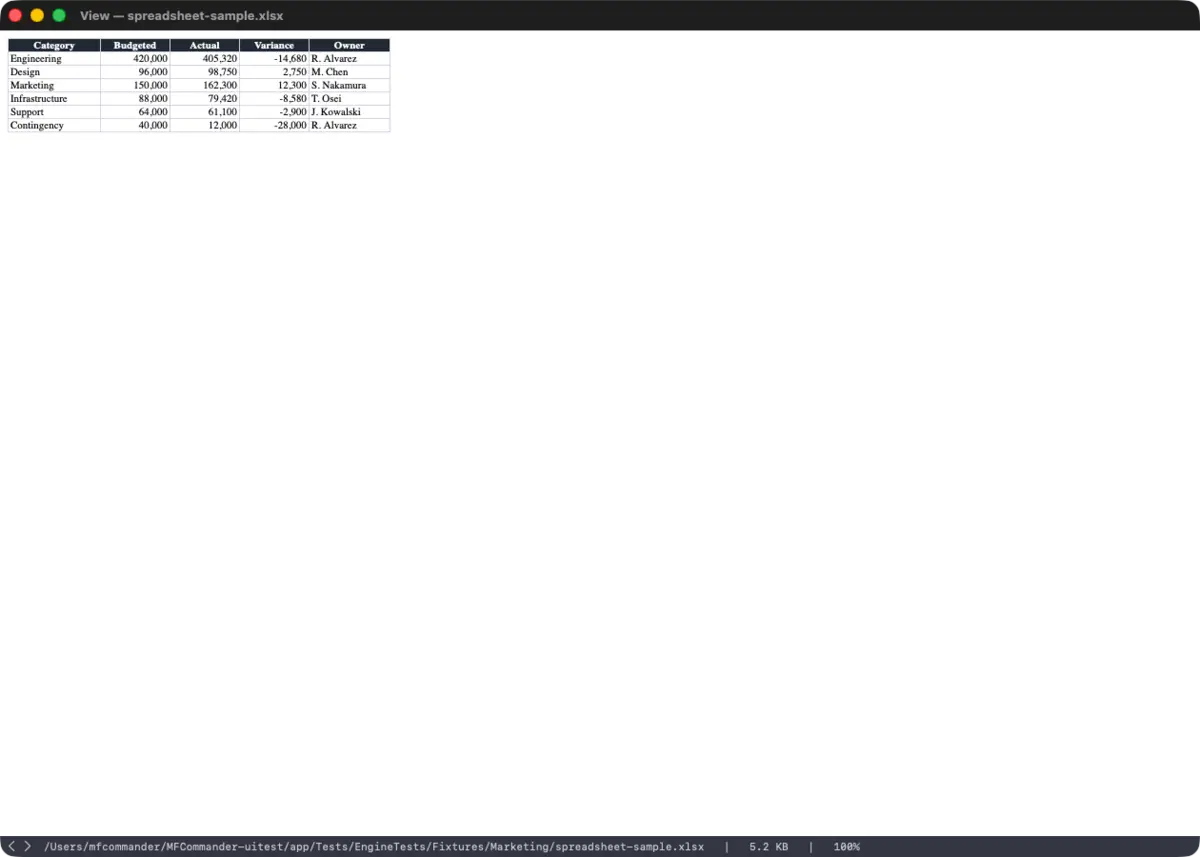
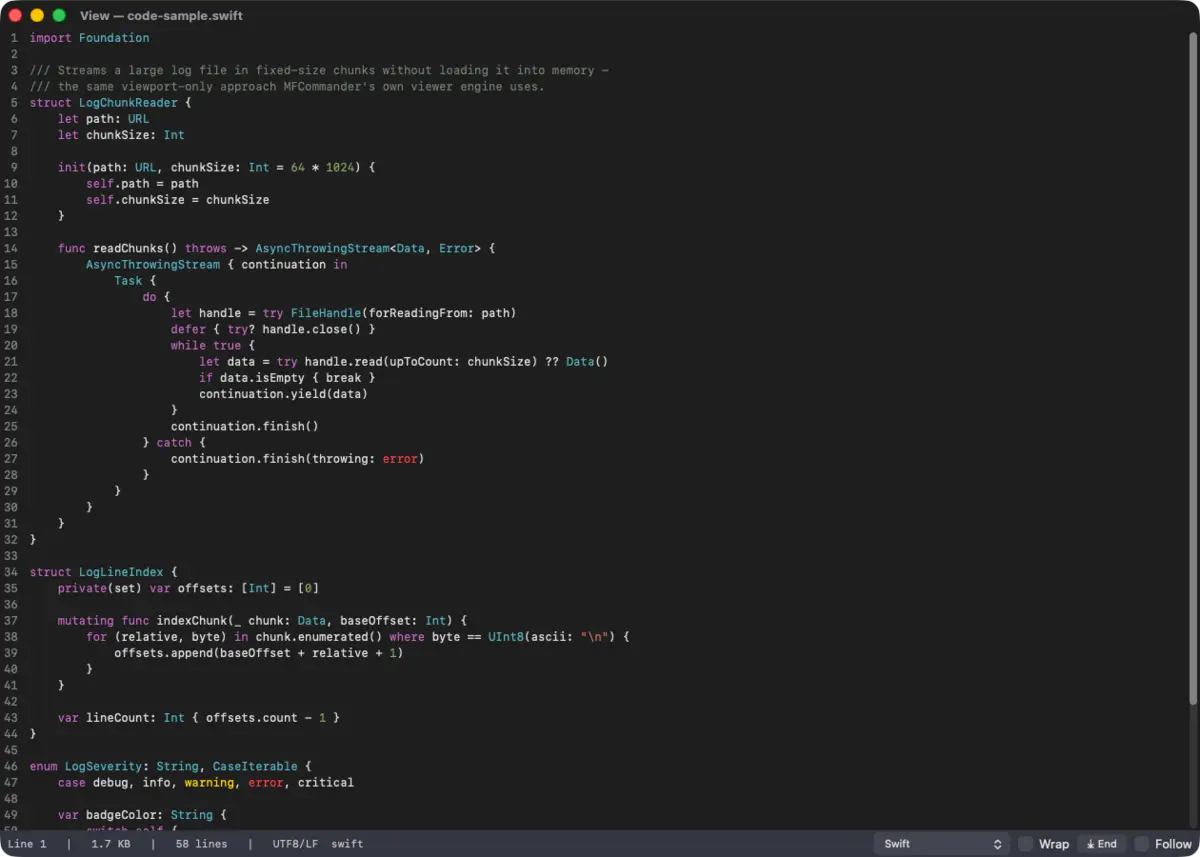
Plain text and logs, with syntax colors for Markdown, JSON, YAML, HTML, XML, CSS, Swift, C, C++, Objective-C, Python, JavaScript, TypeScript, Rust, Go, Java, shell, SQL, TOML, INI, Dockerfiles, and Makefiles. Anything else opens as plain text.
Images
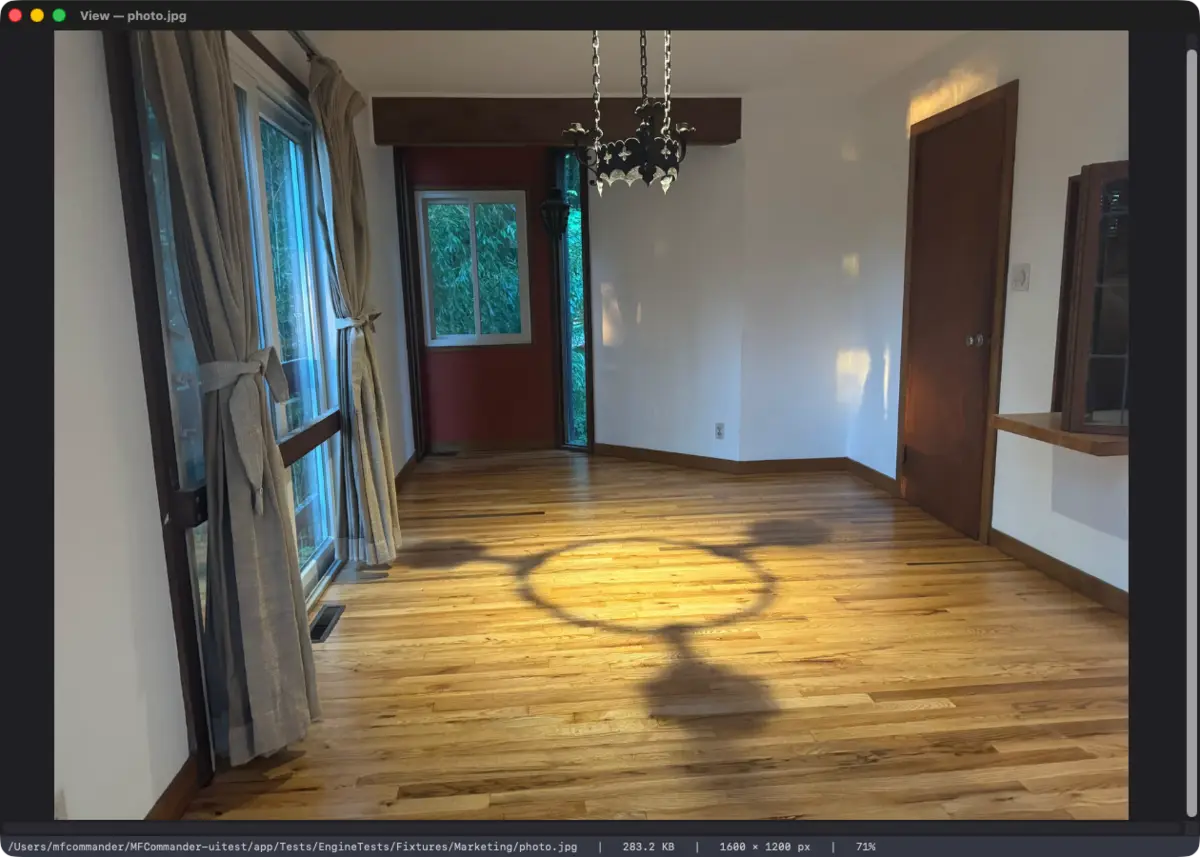
PNG, JPEG, GIF, BMP, TIFF, HEIC, WebP, SVG, and ICNS, with zoom, dimensions, EXIF, and thumbnails in the pane.
Documents
PDF, Word, Excel, PowerPoint, Pages, Numbers, Keynote, RTF, EPUB, property lists, and configuration profiles.
Audio and video
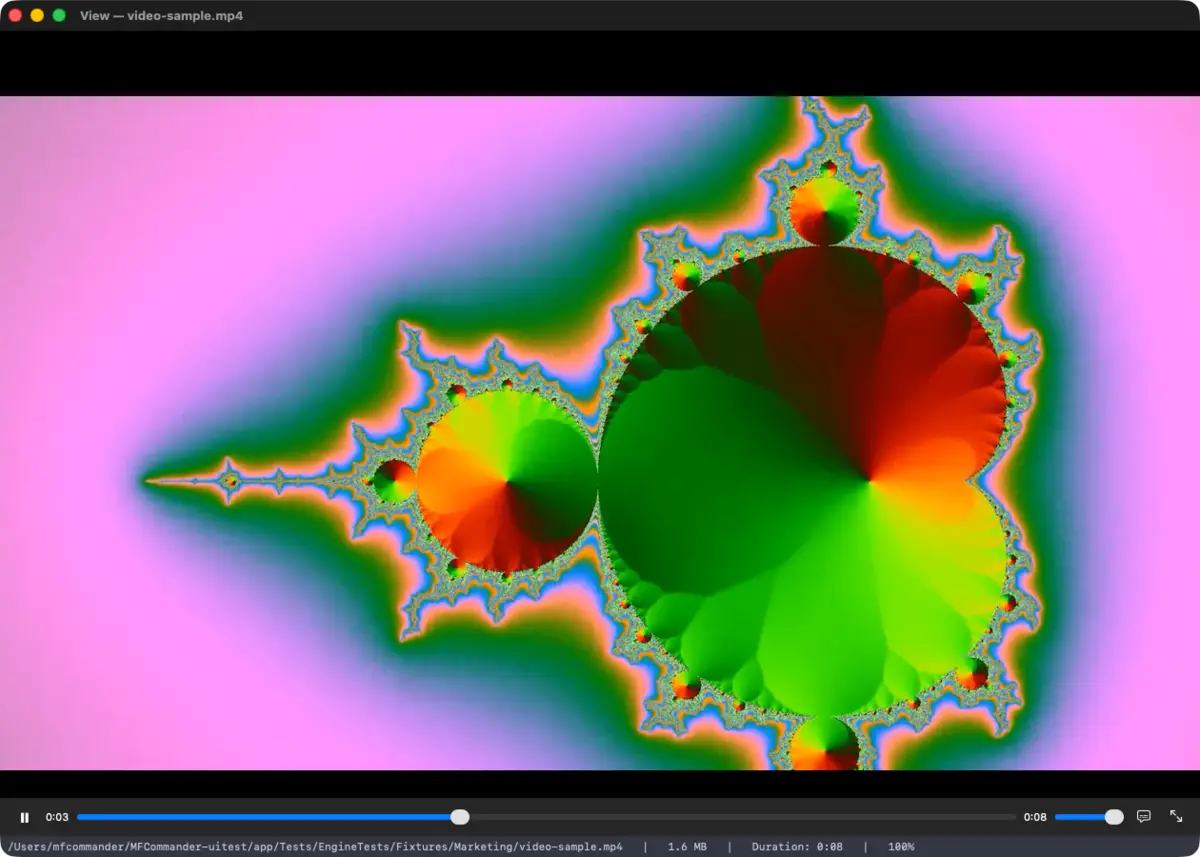
MP4, MOV, M4V, MKV, WebM, AVI, WMV, FLV, MP3, M4A, AAC, WAV, AIFF, CAF, and FLAC, with playback and seeking.
Archives
Walk into ZIP, TAR, GZip, BZip2, XZ, 7z, RAR, CPIO, JAR, and WAR like folders. Create ZIP, tar.gz, or 7z; the rest open read-only.
The part that is actually hard
A 1.09 GB file opens in 33 MB.
That is a real measurement of a real file: 1,092,807,957 bytes of minified JSON on a single line, the worst input a line-oriented viewer can be handed. Peak memory was 33.3 MB. A 256 MB log measures 29.3 MB.
The text and hex viewer memory-maps the file instead of reading it in, indexes line offsets on a background queue, and draws only the viewport you are looking at.
Search the whole file
Find runs over all of it, not just the part on screen, and the match count is the real one.
Jump to any line
Go to Line seeks straight there, however far into the file it sits.
Follow a live log
Keep a file pinned to its end while something is still writing to it.
Highlighting and hex
Syntax colors for the lines on screen, and a hex mode for everything that is not text.
The function keys are where you left them.
The bottom bar every Commander has had since Norton, with the bindings your hands already know. Tab switches panes. All of them remap in Settings.
Two panes, many tabs
Each pane keeps its own tabs, breadcrumbs, sort order, and view mode. Lock a tab and it stays on its folder, so the one you keep coming back to cannot be navigated away by accident.
Transfers run in the background
Copies, moves, and deletes go to a queue you can watch, pause, and cancel.
Find the space and the duplicates
Disk Usage and Duplicate Files open as tabs in a pane, not as separate apps.
Search by name or contents
Search opens as its own tab, and its results are a pane you can act on.
Everything it did, written down and reversible.
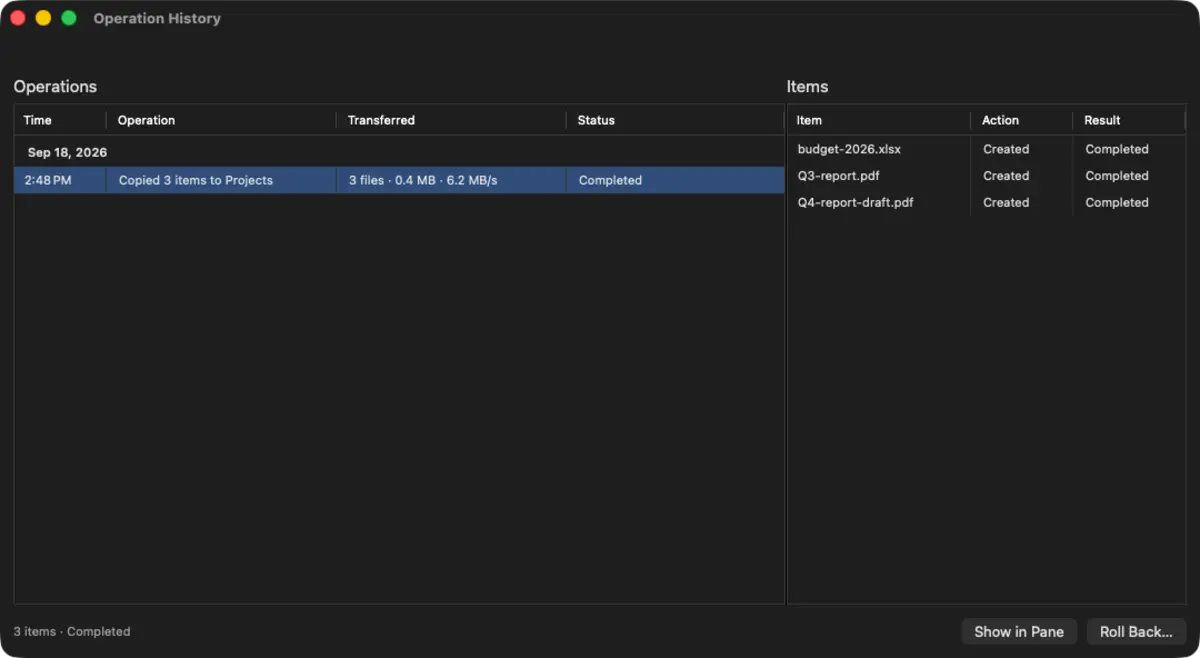
Something that moves thousands of files at a time should be able to tell you what it moved. Every copy, move, rename, and delete is recorded as it happens, so Window ▸ Operation History is a record of the work rather than a list of things you hope went well.
Undo the last one
Edit ▸ Undo reverses the most recent reversible operation. Outside a text field, that is ⌘Z.
Roll back an older one
Select any entry in the history and choose Roll Back to reverse that operation instead of the last one.
It previews before it acts
Review Rollback lists what will be restored and what will be skipped, and every item is checked again at the moment it runs, so anything you have changed since is left alone rather than overwritten.
Kept for as long as you want it
Thirty days by default, or this session only, 7 days, or 90. Clear History empties it on the spot. It stays on your Mac and it is free in Community.
All of this is free, forever.
Community is not a trial of the file manager. We will never nag you to buy one, and nothing on this page is held back to advertise an edition you do not have.
Pro adds the remote connections, so the same viewer reaches SMB shares, SFTP servers, S3 buckets, OneDrive, and Dropbox.